
Books
The New Old Style: Anachronism in Contemporary Comics (University of Nebraska Press, forthcoming in August 2026)

My next book, The New Old Style: Anachronism in Contemporary Comics, is forthcoming with the University of Nebraska Press in the Encapsulations: Critical Comics Studies series.
Description from the UNP website:
The New Old Style explores how the deliberate use of cartooning styles that mimic those of the early twentieth century has paradoxically become one of the most significant vehicles for formal experimentation in contemporary comics. Dubbing this phenomenon “the anachronistic aesthetic,” Matthew Levay argues that what can initially appear to be a nostalgic affinity for outmoded drawing styles is in fact a complex and holistic movement in contemporary comics with profound consequences for how artists and audiences might understand the critical possibilities and historical legacies of the medium itself. The phenomenon of anachronism as an aesthetic mode is visible in North American comics as early as the 1970s, but it rose to prominence in the 1990s. Since then, multiple artists have drawn in ways that reference cartooning styles of the distant past—those of early twentieth-century newspaper comics, early American animation, and midcentury comic books for young children, to name a few. The New Old Style characterizes these cartoonists’ use of anachronism as a mode of critical engagement that reveals how comics, as a medium, can simultaneously interrogate its history—and the violence, misogyny, and racial stereotypes that pervade it—while opening up new ways of addressing its aesthetic conditions. A work of comics history as well as theory, The New Old Style traces the uses of anachronism in comics published from the 1970s to the present and, via a focused set of case studies, argues that those uses represent a wide-ranging critique of the politics of the past, the material culture of the present, and the aesthetic possibilities of the future.
Violent Minds: Modernism and the Criminal (Cambridge University Press, 2019)
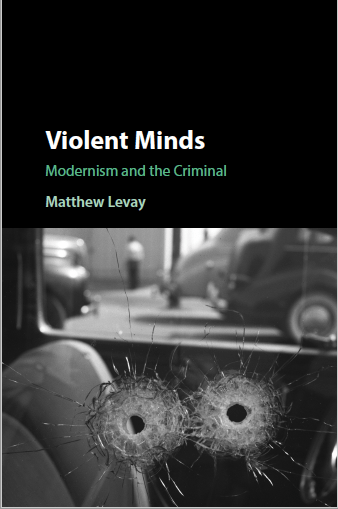
Description from the CUP website:
Just as cultural attitudes toward criminality were undergoing profound shifts in the late nineteenth and early twentieth centuries, modernist authors became fascinated by crime and its perpetrators, as well as the burgeoning genre of crime fiction. Throughout the period, a diverse range of British and American novelists took the criminal as a case study for experimenting with forms of psychological representation while also drawing on the conventions of crime fiction in order to imagine new ways of conceptualizing the criminal mind. Matthew Levay traces the history of that attention to criminal psychology in modernist fiction, placing understudied authors like Wyndham Lewis, Dorothy Sayers, Graham Greene, and Patricia Highsmith in dialogue with more canonical contemporaries like Joseph Conrad, Henry James, Dashiell Hammett, and Gertrude Stein. Levay demonstrates criminality’s pivotal role in establishing quintessentially modernist forms of psychological representation and brings to light modernism’s deep but understudied connections to popular literature, especially crime fiction.
For a brief account of one of the book’s key arguments, see my post on the Cambridge Core Blog, “Can Crime Fiction Be Modernist?”
For recent reviews of the book, see here and here. Additionally, the journal Critical Analysis of Law published a Forum on the book, with my response, in their Fall 2020 issue.
Books in Progress
“Time and Again: Modernism and the Form of the Series”
Editor, Wyndham Lewis, Monstre Gai and Malign Fiesta (The Human Age, Books Two and Three)
I am currently producing a single-volume, scholarly edition of Wyndham Lewis’s novels, Monstre Gai and Malign Fiesta, volumes two and three of Lewis’s trilogy, The Human Age. The book is under contract with Oxford University Press for its Collected Works of Wyndham Lewis series.
Editor, The Cambridge Companion to American Comics

I am also editing a Companion to American Comics for Cambridge University Press, featuring essays from an international team of experts, which will provide a focused introduction to the subject for students and scholars.
Selected Articles
“Highsmith’s Advice: Suspense, How-To, and the Limitations of Genre,” New Literary History (forthcoming).
“Vintage Seth: Comics against Nostalgia,” Modernism/modernity Print Plus 9.3 (May 20, 2025).
“Little Tommy Lost and the Anachronistic Comic,” Comics and Modernism: History, Form, and Culture, ed. Jonathan Najarian (Jackson: University Press of Mississippi, 2024), 284-300.
“Crime Fiction and Criminology,” The Routledge Companion to Crime Fiction, ed. Janice M. Allan, Jesper Gulddal, Stewart King, and Andrew Pepper (London: Routledge, 2020), 273-281.
“Modernism’s Opposite: John Galsworthy and the Novel Series,” Modernism/modernity 26.3 (September 2019): 543-562.
“On the Uses of Seriality for Modern Periodical Studies: An Introduction,” Journal of Modern Periodical Studies 9.1 (2018): v-xix.
“Repetition, Recapitulation, Routine: Dick Tracy and the Temporality of Daily Newspaper Comics,” Journal of Modern Periodical Studies 9.1 (2018): 101-122.
“Preservation and Promotion: Ellery Queen, Magazine Publishing, and the Marketing of Detective Fiction,” The Centrality of Crime Fiction in American Literary Culture, ed. Alfred Bendixen and Olivia Carr Edenfield (New York: Routledge, 2017), 101-122.
“Remaining a Mystery: Gertrude Stein, Crime Fiction and Popular Modernism,” Journal of Modern Literature 36.4 (Summer 2013): 1-22.
“The Entertainments of Late Modernism: Graham Greene and the Career Criminal,” Modernist Cultures 5.2 (October 2010): 315-339.
Selected Review Essays
Review essay on Bloomsbury’s “New Modernisms” book series, edited by Sean Latham and Gayle Rogers. Modernism/modernity Print Plus (14 August 2018).
“Modernism, Periodically.” Review essay on The Oxford Critical and Cultural History of Modernist Magazines: Volume I, Britain and Ireland 1880-1955, edited by Peter Brooker and Andrew Thacker, and Modernism in the Magazines: An Introduction, by Robert Scholes and Clifford Wulfman. Modern Language Quarterly 72.4 (December 2011): 521-535.
From 2016-19, I also wrote an omnibus essay on significant books in modernist studies for the Year’s Work in English Studies.
Other Writing
“Community and the Comic Shop: An Interview with Tony Davis,” The New Americanist 2.1 (May 2023): 108-131.
“Introduction: Modernism in Comics,” Modernism/modernity Print Plus 9.3 (May 20, 2025).
 Matthew Levay